How to Preserve Your Parents' Stories Before It's Too Late
A practical guide to preserving your parents' stories while you still can. Covers DIY recording, interview apps, memoir services, and the easiest way to capture family memories before they're gone.
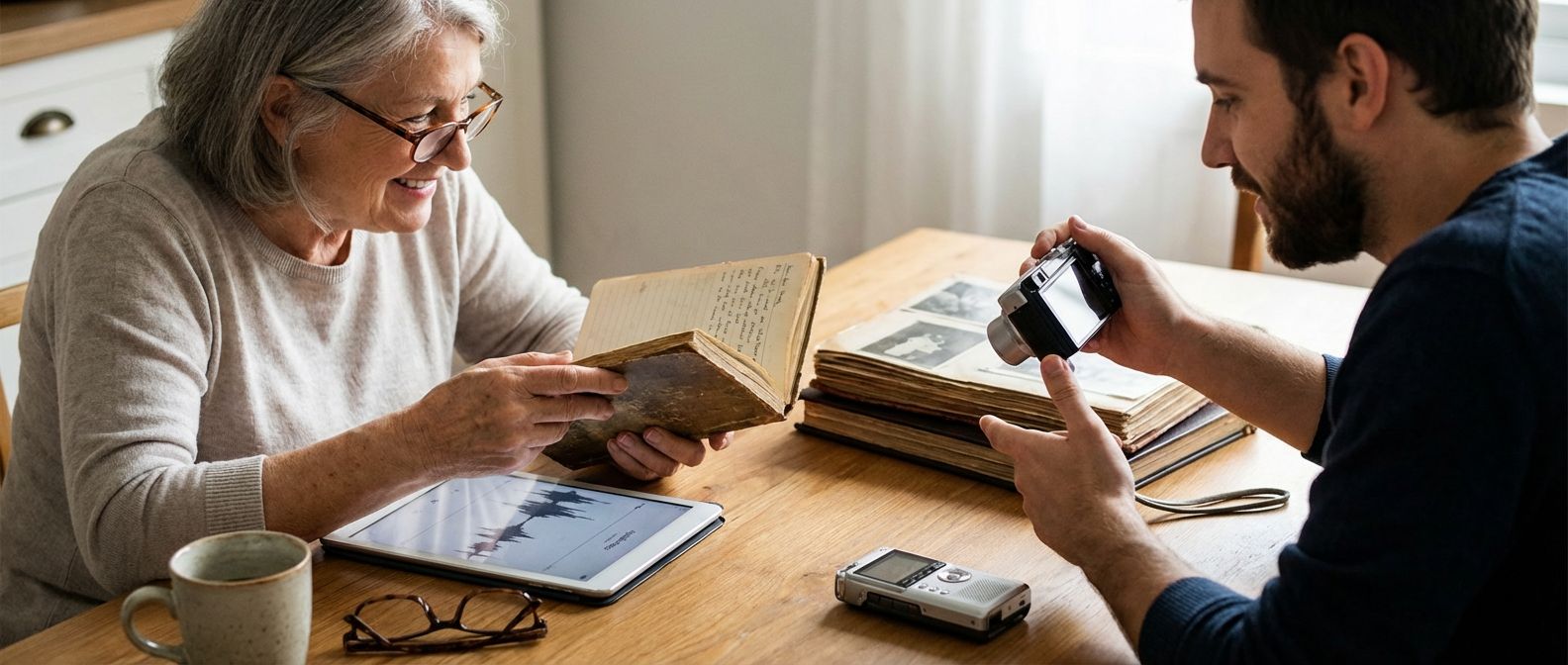
There is a moment that arrives without warning. You are standing in your parents' kitchen, half-listening to a story you have heard a dozen times, and the thought lands: I should be recording this. Then the moment passes. The dishes get done. The drive home is quiet. And the story stays exactly where it has always been -- locked inside the mind of the person who lived it.
Months later, maybe years, you will try to remember the details. The name of the town. The year it happened. The reason it mattered. And you will find that the edges have blurred. Not because the story wasn't important, but because no one wrote it down.
If you are reading this, you probably already feel the urgency. Maybe your parents are getting older. Maybe a health scare sharpened the timeline. This guide covers the real options available to you -- what works, what doesn't, and what each approach actually demands of your time and your family's willingness to participate.
Why Most People Never Get Around to It
The project feels too large, the conversation feels too heavy, and life stays too busy -- so the stories remain unrecorded year after year.
The desire to preserve family stories is common. The follow-through is rare. Most American families have never recorded a single hour of their oldest living generation's memories.
The reasons are predictable and deeply human. Life is busy. The project feels enormous. You don't know where to start. And there is an unspoken awkwardness in sitting your parents down and saying, "Tell me your life story before you can't anymore." That conversation carries a weight most people aren't ready to bear.
So the project stays on the list. Year after year. Until it can't be on the list anymore.
The goal here is not to make you feel guilty. It is to show you that preserving your parents' stories does not have to be a massive undertaking. The best approach is the one you will actually do.
Option 1: DIY Recording with Your Phone
The simplest approach requires no special equipment. Your phone has a voice recorder. Your parents have stories. Put them together.
Set aside 30 to 60 minutes. Sit across from your parent in a quiet room. Press record. Ask questions. Listen.
What's good about it: It costs nothing and captures your parent's actual voice -- something no written account can replace. It can be done today with no accounts or subscriptions.
The challenges: Most people underestimate how difficult it is to be a good interviewer. Without preparation, conversations wander. Long silences feel uncomfortable. You end up with 45 minutes of audio that is mostly you saying "uh-huh" while your parent talks about what they had for lunch.
There is also the storage problem. A raw audio file on your phone is not a preserved story. It is a file that will eventually be deleted during a storage cleanup or lost in a phone upgrade. If you go this route, back up the files immediately, label them clearly, and accept that raw recordings are the beginning of preservation, not the end.
Option 2: Prompted Journals and Interview Services
Products like StoryWorth, Remento, and prompted journals try to solve the blank-page problem by providing structure. Some send weekly email prompts. Others provide a physical book with questions to answer.
What's good about it: Structure helps. Having a specific question is easier than staring at a blank page. Services like StoryWorth produce a tangible printed book.
The challenges: These products put all the work on your parent. Every single one requires the subject to sit down, repeatedly, and do the writing or recording. Many prompted journals are abandoned within the first month. StoryWorth subscriptions frequently produce books with entire chapters left blank. The issue is not the product -- it is human nature. Your parent has to want to do this, remember to do it, and sustain the effort over weeks or months.
Option 3: Professional Memoir and Video Services
Professional memoir writers and video biography companies will send an interviewer to your parent's home, conduct multiple sessions, and produce a polished written or video memoir.
What's good about it: The quality can be exceptional. A skilled interviewer draws out stories that would never emerge from a prompted journal. The final product is beautiful and built to last.
The challenges: Cost is the primary barrier. Professional memoir services typically start at $5,000 and can exceed $20,000. These projects also require your parent to sit for multiple interview sessions -- three to six hours total, spread across several weeks. For parents dealing with health issues or cognitive decline, this may not be feasible.
Option 4: StoryCorps and Community Recording Projects
StoryCorps is a nonprofit that has been recording personal stories since 2003. They operate recording booths in select cities and offer a free app for remote recording.
What's good about it: It is free or very low cost, and the recording is preserved in the Library of Congress. Having a facilitator present can ease the awkwardness of the conversation.
The challenges: Availability is limited. StoryCorps booths exist in only a handful of cities. The app is available everywhere, but it puts the facilitation burden back on you. And the output is a raw recording -- meaningful, but not a produced narrative.
Option 5: AI-Assisted Story Preservation
A newer category of service uses conversational AI to make the process faster and easier. Edmund Grey is one example. Instead of requiring the subject to participate at all, you -- the son, daughter, or grandchild -- have a 20-minute voice conversation about the person you love. The service then produces a professionally narrated 40-minute audio biography, delivered the same day, for $39.
You speak with an AI interviewer who guides you through your memories -- their personality, their stories, the defining moments of their life. Afterward, the service researches historical context, writes a 6,000-word narrative, and produces a fully narrated audio story.
What's good about it: The friction is almost zero. You don't have to convince your parent to participate or sustain effort over weeks. One conversation, one payment, and the finished product arrives the same day.
The challenges: You are telling the story from your perspective, not your parent's. The memories are yours -- the stories you were told, the moments you witnessed, the details you carry. The final story reflects your relationship with your parent rather than a comprehensive autobiography. For many families, that is exactly what makes it meaningful. But if you want your parent's own voice and unfiltered perspective, this approach won't provide that.
Conversation Starters: What to Ask Your Parents
The best questions focus on specific moments rather than broad timelines -- ask about earliest memories, defining choices, and the stories your family has told more than once.
Whether you use a service or sit down with your phone, the hardest part is often knowing what to ask. Here are questions that tend to unlock the richest stories.
About Their Childhood
- What is your earliest memory?
- What was your house like growing up?
- Who was your best friend as a child, and what did you do together?
- Was there a teacher or neighbor who changed the direction of your life?
About Defining Moments
- What is the hardest thing you have ever been through?
- When did you first feel like an adult?
- Was there a moment when you realized life was going to be different than you expected?
About Family and Relationships
- How did you meet Mom/Dad? What was the first year like?
- What surprised you about becoming a parent?
- What family tradition matters most to you, and where did it come from?
- Is there something you wish you had told your own parents?
About Identity and Legacy
- What do you want your grandchildren to know about you?
- What are you most proud of that nobody knows about?
- If you could live one day of your life again, which would it be?
The best question is often the simplest: "Tell me about a time when..." and then let them talk. Resist the urge to fill silences. The best stories often come after a pause.
The Real Cost of Waiting
The irreplaceable parts of your parents' stories -- the emotional truths, the small details, the reasons behind their choices -- fade a little more with each passing year.
There is no comfortable way to say this, so here it is plainly: the window for preserving your parents' stories has an expiration date. Cognitive decline, illness, and death are not abstract concepts for the people reading this article. They are the reason you searched for this in the first place.
The stories your parents carry are irreplaceable. Not the facts and dates -- those can often be found in records. The irreplaceable parts are the emotional truths. How it felt to immigrate to a new country with two suitcases. Why your mother kept that particular photograph on the mantle. The promise your father made to his own father that shaped every decision afterward.
These stories live only in the memories of the people who were there. And every year that passes, some of those details fade -- even for the people who lived them.
You do not need the perfect approach. You need 20 minutes and the willingness to start. Record a conversation on your phone. Buy a prompted journal and fill it out together. Or visit edmundgrey.com and let someone else handle the hard part.
The only approach that truly fails is the one you never begin.
Frequently Asked Questions
How long does it take to preserve a parent's story?
It depends on the approach. A DIY phone recording takes 30 minutes to several hours across multiple sessions. Prompted journals like StoryWorth unfold over a year. Professional memoir services require 3-6 hours of interviews spread over weeks. Edmund Grey produces a finished 40-minute audio story from a single 20-minute conversation, delivered the same day. The right timeline depends on how much time you have and how much effort you can realistically sustain.
What if my parent has dementia or significant memory loss?
If your parent can still hold a conversation, even with gaps, there is still value in recording what they share. Earlier-stage memory loss often leaves long-term memories relatively intact even as recent memories fade. For families where the subject cannot participate at all, services like Edmund Grey allow you to tell their story from your own memories -- the stories they told you, the moments you shared, the person you knew.
Is it better to record audio or video of my parents?
Both have value, but they serve different purposes. Video captures facial expressions, gestures, and physical presence. Audio is easier to produce, less intimidating, and more likely to result in natural, unguarded conversation. Most people behave differently on camera. If your parent is comfortable with video, do it. If they are not, audio will produce a better recording. The format matters far less than whether you actually press record.
The stories your parents carry will not wait for the perfect moment. Start preserving them today.
Create a Life Story at edmundgrey.com
Related Guides
- If you want a version of this process that does not depend on the subject participating, How to Preserve Family Stories Without Asking Your Parents to Do Anything goes deeper.
- For service comparison and gift framing, read StoryWorth vs Remento vs Edmund Grey: Which Family Story Service Is Right for You? and What Is a Life Story? The New Way to Give a Meaningful Gift.
Ready to create a Life Story for someone you love?
Start Free InterviewRelated Guides
Keep reading
25 Questions That Unlock People's Best Stories About Someone
Collecting memories for a tribute? These 25 questions help friends, family, and coworkers share real stories about someone instead of generic praise.
How to Organize a Group Gift Without Chasing People for Weeks
How to organize a group gift without chasing coworkers, cousins, or friends for weeks. A practical plan for deciding, collecting money, and delivering on time.
Audio Tribute vs. Video Montage: Which Group Gift Lands Harder?
Audio tribute or video montage for your group gift? An honest comparison of effort, participation, cost, and which format the recipient returns to.